
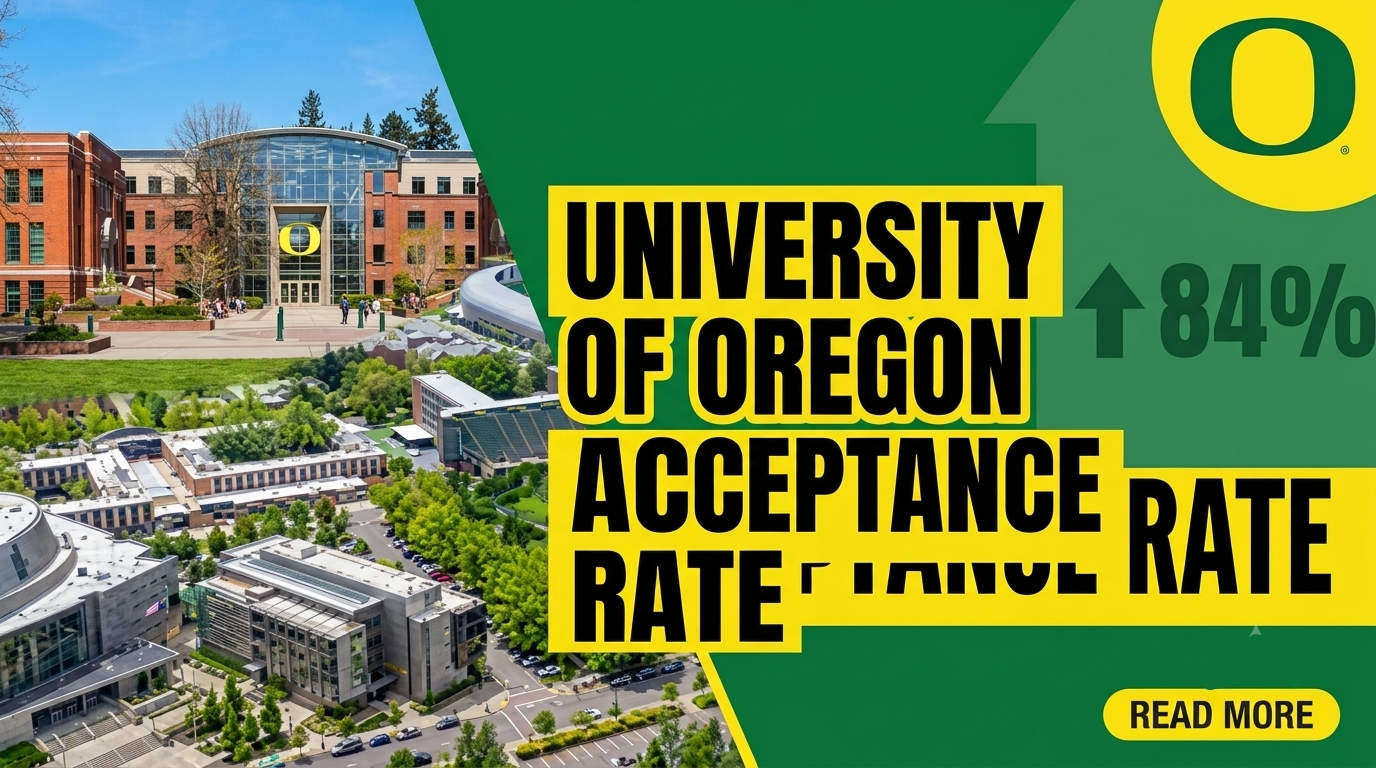
University Of Oregon Acceptance Rate: Admission Requirements And What To Know
If you are thinking about applying to the University of Oregon, one of the first things you should check is how difficult it is to get admitted. The University of Oregon acceptance is shows the percentage of students who apply and are offered admission, giving you a general idea of how competitive the university is.
However, the acceptance rate is not the only thing that matters. The university may also look at your high school grades, the subjects you studied, your application essay, activities outside the classroom and other parts of your academic record. The University of Oregon is also test-optional, so applicants can apply without submitting SAT or ACT scores.
In this article, we will explain the University of Oregon acceptance rate in simple terms. We will also cover the admission requirements, GPA, application deadlines and other important things you should know before applying.
What Is The University Of Oregon Acceptance Rate?
The University of Oregon acceptance rate refers to the percentage of applicants who are offered admission during a particular admission cycle.
It is important to understand that an acceptance rate is not a personal probability of admission. For example, if a university has an acceptance rate of 80%, that does not mean every applicant has an 80% chance of being accepted.
Applicants can have very different academic backgrounds, coursework, essays, activities and other circumstances.
For that reason, students should use the acceptance rate as a starting point rather than the only factor when deciding whether to apply.
The University of Oregon’s official Common Data Set is the most appropriate place to look for standardized admission statistics. The university currently provides its 2025-26, 2024-25 and 2023-24 Common Data Sets, along with older reports. University of Oregon Office of Data Enablement
Is The University Of Oregon Hard To Get Into?
The answer depends on the applicant.
A university’s overall acceptance rate cannot tell the complete story of an individual application. The University of Oregon says it uses a holistic review process, meaning admissions staff look at the applicant as a whole rather than focusing only on GPA or standardized test results.
The university considers several areas, including:
- Strength of high school coursework
- Grade trends
- GPA
- SAT or ACT scores when submitted
- Personal statement
- Extracurricular activities
- Academic interests
- Special talents
- Life experiences and special circumstances
The university also says that the strength of an applicant’s high school curriculum is important. Students are encouraged to continue taking challenging academic courses through their senior year. University of Oregon holistic review process
This means that simply comparing your GPA with an acceptance-rate percentage may not give you a complete picture of your admission prospects.
University Of Oregon Admission Requirements
Before worrying about the acceptance rate, it is important to understand the basic requirements for first-year applicants.
The University of Oregon requires applicants to complete college-preparatory coursework in five subject areas: English, mathematics, science, social studies and a foreign language.
The university says first-year applicants need 15 units of college-preparatory courses across these areas. The university also states that only grades of C- or better are accepted for these required courses.
Applicants must also provide their academic information through the university’s required self-reported transcript process, known as STARS, or through the appropriate section of the Common Application.
The university uses the information provided in the academic record as part of its admission and scholarship review. UO first-year admission requirements
What GPA Do You Need For The University Of Oregon?
GPA is an important part of the University of Oregon admission process, but the university does not treat GPA as the only measure of an applicant.
The University of Oregon uses a cumulative weighted GPA for admission and scholarship consideration. Its system can give additional weight to certain advanced courses, including Advanced Placement, International Baccalaureate, Cambridge and dual-enrollment courses.
The university also looks at the academic context surrounding an applicant’s grades.
For example, the admissions office considers the difficulty of the courses a student has taken and whether the student’s grades have improved over time.
The university states that applicants with a GPA below 3.00 can still be reviewed through its alternative admission process, although applicants below that level are generally not considered for admission. Students in this situation are encouraged to explain circumstances that affected their academic performance.
Therefore, students should not assume that a single GPA number automatically guarantees admission or rejection.
Also Read: University Of Florida Acceptance Rate: Full Breakdown What You Need To Know
Does The University Of Oregon Require The SAT Or ACT?
The University of Oregon is test-optional for first-year admission.
This means applicants can be considered for admission without submitting SAT or ACT scores.
If an applicant chooses to submit scores, the university says SAT and ACT scores are considered equally. The university also states that standardized test scores play little to no role in its admissions process.
For scholarships, the university says it is test-blind, meaning SAT and ACT scores are not considered for merit- or need-based awards.
This makes the academic record, coursework, essay and other parts of the application particularly important for students who do not submit test scores.
What Does The University Of Oregon Look For In Applicants?
The University of Oregon describes its admission process as holistic.
In simple terms, this means the admissions team wants to understand more than just your grades.
1. Strong Academic Coursework
The courses you take in high school matter. The university considers the strength of your academic program when reviewing your application.
Taking challenging courses can demonstrate academic preparation and motivation.
2. Grade Trends
Your grades over time can also matter.
A student whose grades improve during high school may present a different academic picture from a student whose performance consistently declines.
The University of Oregon specifically identifies grade trend as one factor in its review process.
3. Personal Statement
Your application essay gives the university an opportunity to learn things about you that may not be obvious from your transcript.
The university says the essay can help admissions staff understand your academic motivation and better understand your fit with the university.
4. Extracurricular Activities
Activities outside the classroom can also be considered.
These may include clubs, sports, jobs, volunteer activities, college-preparation programs and other interests.
The important point is that applicants do not need to participate in every possible activity. What matters is presenting an accurate picture of your experiences and interests.
5. Special Circumstances
The University of Oregon also considers special circumstances that may have affected an applicant’s academic performance.
Students can provide additional information about circumstances that affected their education.
University Of Oregon Application Deadlines
For first-year students applying for fall admission, the University of Oregon currently lists two main application deadlines:
| Application Option | Deadline |
|---|---|
| Early Action | November 1 |
| Regular Decision | January 15 |
Supporting documents are generally due by November 15 for Early Action and February 15 for Regular Decision.
The university says Early Action is non-binding. Applicants who apply by the Early Action deadline receive an admission decision earlier than Regular Decision applicants.
For the current application cycle, the University of Oregon says applications for Fall 2027 are open. Since deadlines can change, applicants should verify dates directly with the university before submitting an application.
Does The University Of Oregon Have Different Requirements For Some Majors?
Yes.
One important detail that can be missed when researching the overall University of Oregon acceptance rate is that some majors and programs have additional admission requirements.
The university explains that admission to the University of Oregon and admission to certain programs can be separate decisions.
For example, some programs may require additional applications, essays, portfolios, auditions or other materials.
Architecture, music, product design and some other programs have additional requirements or processes.
Therefore, if you already know what you want to study, do not rely only on the university’s general admission information. Check the requirements for your intended program as well.
University Of Oregon Acceptance Rate For International Students
International students should be careful when looking at the overall University of Oregon acceptance rate.
An overall university acceptance rate does not necessarily describe the admission experience of every international applicant.
International students may have additional requirements, particularly relating to English-language proficiency and documentation.
The University of Oregon provides specific English-proficiency requirements for international undergraduate applicants. Accepted testing options include TOEFL, IELTS and the Duolingo English Test, among others, depending on the applicant’s circumstances and the current requirements.
Meeting an English-proficiency score requirement does not guarantee admission.
International applicants should therefore review the university’s dedicated international admissions information instead of assuming that the general acceptance rate tells the entire story.
How Can You Improve Your University Of Oregon Application?
There is no guaranteed formula for admission, but applicants can take practical steps to present a stronger application.
First, take your high school coursework seriously. The University of Oregon specifically considers the strength of the courses you take.
Second, keep your grades as strong as possible and pay attention to your academic progress throughout high school.
Third, take the application essay seriously. Use it to explain your experiences, interests, goals or circumstances in your own words.
Fourth, complete the required academic record accurately. The university warns applicants not to enter grades or coursework from memory when completing STARS. Applicants should use their transcript to provide accurate information.
Finally, check deadlines carefully. An otherwise strong application can face problems if required materials are missing or submitted late.
Is The University Of Oregon Test-Optional?
Yes. The University of Oregon is test-optional for first-year admission.
This means you can apply without submitting SAT or ACT scores.
If you decide to submit scores, the university says it considers SAT and ACT equally. It also says test scores have little to no role in its admission review and are not used for scholarship eligibility.
Applicants should therefore focus on the parts of the application that the university actually emphasizes, including academic preparation, grades, essays, activities and other relevant circumstances.
Is Oregon State University A Good School?
Oregon State University is a public research university in Corvallis, Oregon. It offers a wide range of undergraduate and graduate programs and is classified as an R1 research university. The university also has campuses and learning options beyond Corvallis, including OSU-Cascades and its online Ecampus.
However, Oregon State University is different from the University of Oregon. Students comparing the two should look at factors such as available majors, location, tuition, campus environment and academic programs before choosing a school.
Where Is The University Of Oregon Located?
The University of Oregon’s main campus is located in Eugene, Oregon, at 1585 East 13th Avenue, Eugene, OR 97403. The Eugene campus covers about 295 acres and is located near the Willamette River in Oregon’s southern Willamette Valley.
The university also has a campus in Portland. However, Eugene is the primary campus most students associate with the University of Oregon.
Frequently Asked Questions About The University Of Oregon Acceptance Rate
How Many Students Are At The University Of Oregon?
The University of Oregon had 24,448 total students in fall 2025, according to the university’s official facts and figures. This included 20,711 undergraduate students and 3,737 graduate students.
The university also reports students from all 50 U.S. states, four U.S. territories and 96 countries, giving the campus an internationally diverse student population.
Does The University Of Oregon Have A Nursing Program?
No. The University of Oregon does not have a nursing program. However, students interested in nursing can complete certain pre-nursing courses and pursue a bachelor’s degree at UO before applying to an eligible nursing program at another institution.
The university’s Pre-Health Advising office notes that students interested in nursing may consider majors such as Human Physiology or Multidisciplinary Science while completing the prerequisites needed for later nursing education.
Therefore, students who specifically want to earn a BSN directly from their undergraduate university should look at institutions that offer an accredited nursing program.
What Is The University Off Oregon Known For?
The University of Oregon is known for its research, academics, athletics and strong connection to the Pacific Northwest. The university is an R1 research institution and offers more than 300 degree and certificate programs.
The university is also widely associated with its track and field tradition. Its Eugene campus is sometimes referred to as “TrackTown USA” because of Eugene’s long connection with the sport. UO also has academic strengths and research activity across areas such as science, design, education, journalism, business, law, art and music.
For students researching the University of Oregon, its combination of academic programs, research opportunities, campus life and athletics are some of the major features to explore before applying.

Meet The Author
Peter onuoha is the founder and editor of Academicfocus, with over a decade of experience in education publishing. He covers education updates on, university schools fees, admission portal, cut off mark, jamb update opportunities and related public information. Connect with him on facebook